Power customer-centric decisions with intent tags
Posted on February 18, 2026

Article
Every day, your team makes decisions that shape customer experiences and business outcomes. But how many of those decisions are informed by what customers actually need? The most successful organizations consistently keep a pulse on two fundamental questions:
- Why are customers reaching out?
- Are we helping them with what they need?
The answers live in your support conversations. Decagon’s insights and analytics tools analyze thousands of interactions each day to surface what customers care about and where to improve.
It starts with intelligent tagging, where intent tags uncover what customers are actually trying to do. Here’s how you can put intent tags to work.
Identify intent trends automatically
Intent tags automatically categorize every conversation by the customer’s goal, so you can understand why they’re reaching out and whether your AI agent is effective at resolving their inquiries.
Intent tags enable you to:
- Auto-generate conversation categories that identify common customer goals and challenges
- Prioritize improvements to your agent and product roadmap
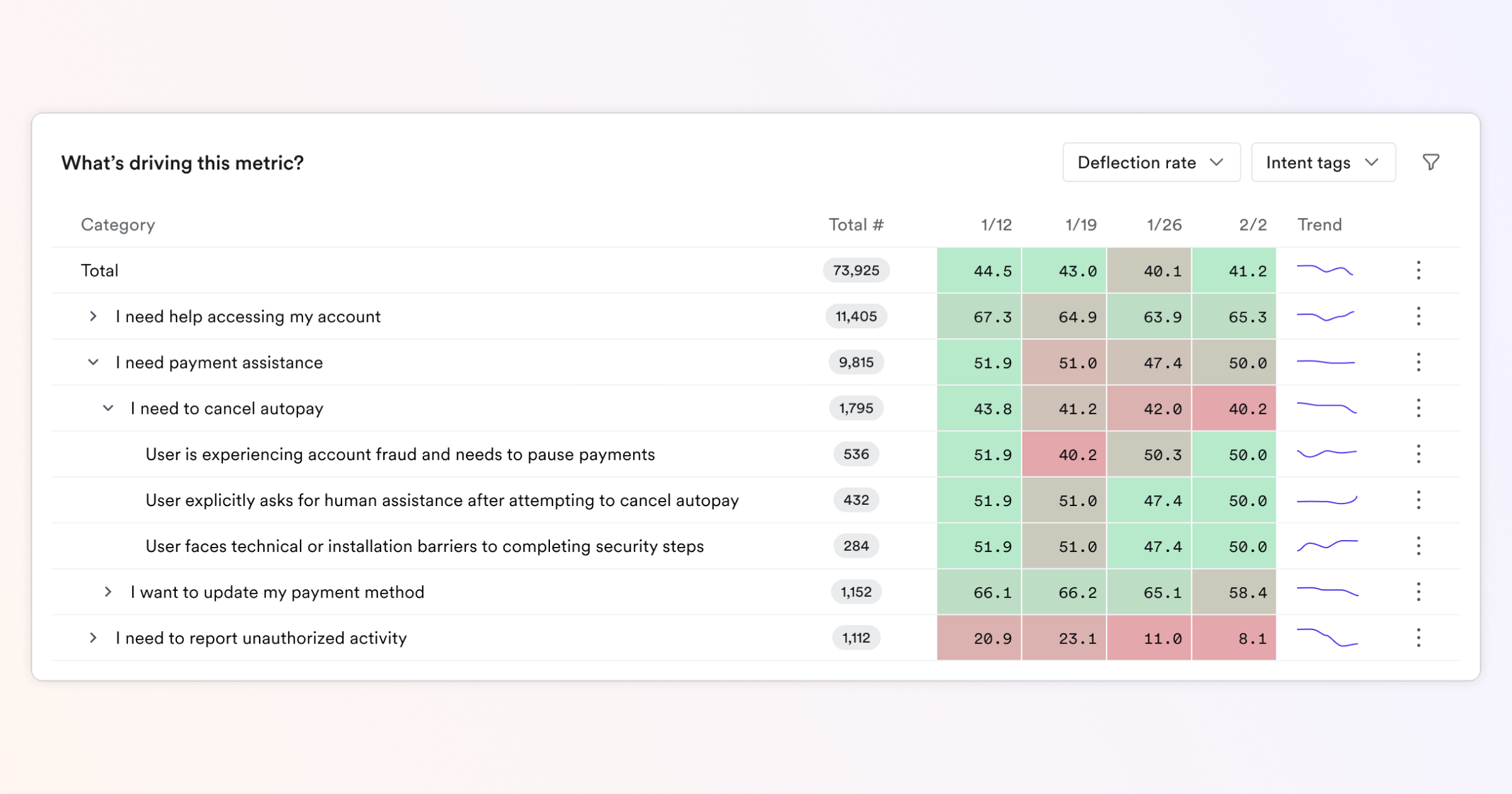
- Surface the top drivers of CSAT drops and deflection by each customer intent
Translate customer goals into product improvement
To generate actionable insights, intent tags are organized into three levels of granularity. You can zoom out for the big picture or drill down into the specifics.
Level one captures broad themes like "I need help with a payment." Level two captures the specifics behind each request, such as a cluster of customers reaching out to update their payment method or cancel autopay. Level three goes deeper, mapping out conversation outcomes and helping you pinpoint common user patterns before escalation and deflection.
These insights turn customer conversations into a roadmap for product improvement. Say you notice a spike in support volume. Manual tags can categorize them all under "billing", which might be helpful for reporting, but is ultimately not very actionable. On the flip side, intent tags can show you that most of those conversations are specifically about canceling autopay. Now you have a clear next step: dig into your autopay flow, find the friction points, and ship a fix.
Identify opportunities to improve agent performance
Knowing what your customers need is only half the picture. Intent tags also show you how well your agent is handling each of those needs, so you can consistently improve customer experiences.
Each intent comes paired with performance metrics like deflection rates, CSAT scores, and escalation patterns. Together, they pinpoint exactly where your support experience is working and where it's breaking down.
For example, you might notice that customer conversations about shipping are escalating at a high rate, even though your AI agent should be resolving them. By viewing outcomes and sample conversations, you can detect where your Agent Operating Procedure (AOP) is underperforming. You can then jump into your AOP to make updates, test changes, and re-launch that AOP for better results.
Act on insight faster
With intent tags, you gain immediate insight into what your customers need and where you can better support them. With clear visibility into intent and outcomes, you can prioritize fixes, update AOPs, and ship product improvements with confidence.
Book a demo to start answering the questions that drive your business forward.

Start improving your workflow with Decagon
With Decagon, CX teams don’t have to guess whether a change will improve CSAT or deflection. They can move quickly, measure what matters, and act on what works.
Join us
There are very few places where you can prototype with frontier LLMs, ship to production in days, and watch users engage with the systems you built—all while owning the entire stack, from intent parsing and tool usage to API integration and observability. This role at Decagon is one of those places.
From my own experience working across both agent development and broader engineering initiatives at Decagon, I’ve seen firsthand how uniquely impactful this work can be. Whether I’m building intelligent workflows for customers or designing infrastructure that supports our agent platform, it’s rare to find an environment where the work transitions from concept to production within days, actively powering user experiences and transforming how businesses operate.
If you’re looking for a role where you can:
- Build at the frontier of LLMs, automation, and user interaction
- Deploy AI agents that solve high-value business use cases across industries including retail, travel and hospitality, fintech, edtech, and more
- Work directly with customers on high-impact use cases
- Ship fast, iterate constantly, and own your work from idea to production
- Join a fast-moving, collaborative team solving real-world challenges with AI
We’d love to hear from you!
.png)

.svg)

.svg)

.svg)

.svg)

.svg)

.svg)

.svg)
The AI concierge for every customer.